Signed in as:
filler@godaddy.com
Crypto moves in cycles driven by market psychology, Bitcoin dominance, global liquidity, adoption, and geopolitical events.
This cheat sheet breaks down:
• The 2009–2013 cycle
• The 2014–2017 cycle
• The 2018–2021 cycle
• The 2022–2025 cycle
Learn how Bitcoin historically peaks first, how altcoins usually follow later, and why accumulation phases matter for long-term investors.
This guide also explains:
• Bitcoin vs altcoin volatility
• Dollar cost averaging strategies
• Market psychology during fear and greed
• Why timing short-term trades is riskier
• Why long-term utility projects have historically performed better over time
Bitcoin, Ethereum, Solana, XRP, and HBAR are examples of major cryptocurrencies that many investors watch closely for long-term utility and adoption trends.
This educational guide is designed to help beginners better understand historical crypto market behavior and cycle timing. Blockchain Blueprint does not provide financial or investment advice.
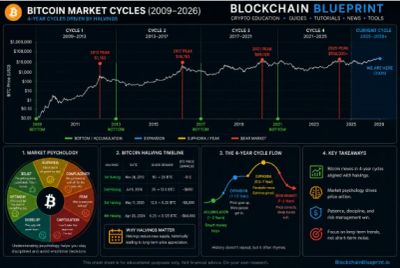
Crypto markets historically move in repeating cycles driven by investor psychology, Bitcoin halvings, liquidity, adoption, regulation, and global economic events.
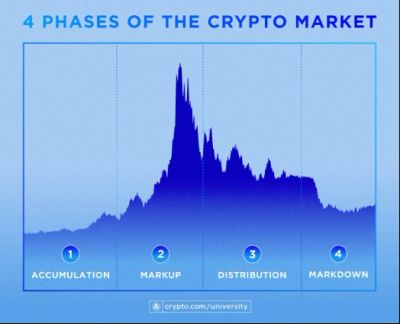
Most crypto cycles follow a similar pattern:
• Accumulation Phase
Smart money and long-term investors slowly accumulate assets while fear is high and public interest is low.
• Breakout Phase
Bitcoin begins recovering and breaking major resistance levels. Confidence slowly returns to the market.
• Expansion & Euphoria Phase
Retail investors flood into the market, altcoins surge rapidly, meme coins explode, and media attention reaches extreme levels.
• Distribution Phase
Large holders begin taking profits while retail investors continue buying aggressively near market tops.
• Bear Market & Capitulation Phase
Prices fall sharply, fear returns, leverage is wiped out, and weak projects collapse.
• Recovery Phase
Markets stabilize, long-term investors re-enter, and the cycle slowly begins again.
Historically, Bitcoin usually leads the market first, while altcoins often follow later with more volatility. Many altcoins can rise much faster during bull markets, but they can also experience much deeper corrections during bear markets.
Because crypto markets are highly emotional and volatile, many long-term investors prefer dollar cost averaging strategies instead of attempting to perfectly time tops and bottoms.
Understanding market cycles can help investors better recognize periods of fear, greed, accumulation, and hype within the crypto market.
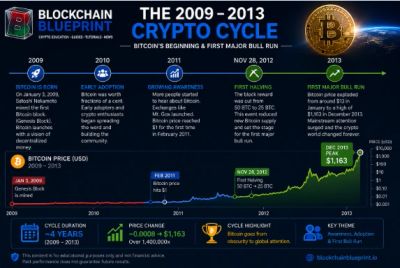
Bitcoin was created in 2009 by the anonymous creator known as Satoshi Nakamoto during the aftermath of the global financial crisis. The creation of Bitcoin introduced the idea of decentralized digital money that could operate without banks or governments controlling transactions.
During the early years of crypto, adoption was extremely small and public awareness was limited. Bitcoin traded for only a few cents in its earliest days, and many people did not understand the technology or believe it would survive long term.
As awareness slowly increased between 2010 and 2013, Bitcoin experienced its first major market cycle. Early adopters, technology enthusiasts, and online communities began accumulating Bitcoin as interest in blockchain technology started growing.
Key events during this cycle included:
• The launch of early crypto exchanges
• Growing media attention
• Increased merchant adoption
• The rise of online Bitcoin communities
• The first major Bitcoin bull market
By 2013, Bitcoin experienced a powerful rally that introduced millions of people to cryptocurrency for the first time. However, the market also became highly volatile, leading to major corrections afterward.
This first cycle established the foundation for future crypto market cycles and demonstrated how rapidly emotions, speculation, and adoption could affect digital asset prices.
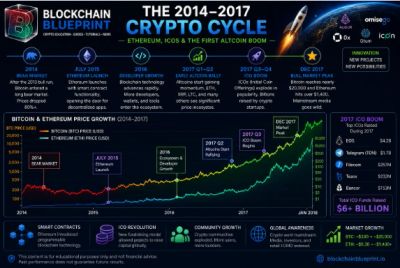
After the 2013 Bitcoin rally, the crypto market entered a major bear market throughout 2014 and early 2015. Prices dropped heavily, public interest faded, and many people believed cryptocurrency was finished.
However, during this quieter period, blockchain technology continued developing rapidly behind the scenes.
One of the biggest events during this cycle was the launch of Ethereum in 2015. Ethereum introduced smart contracts, allowing developers to build decentralized applications and blockchain-based systems beyond simple digital payments.
As Ethereum adoption expanded, thousands of new cryptocurrency projects entered the market. This eventually led to the ICO boom.
An ICO (Initial Coin Offering) was a fundraising method used by crypto startups to raise money by selling digital tokens to early investors.
Many people compared ICOs to IPOs (Initial Public Offerings), where companies raise capital from public investors through the stock market. However, instead of selling company shares, ICOs sold blockchain-based digital tokens.
During this period, investors flooded into the crypto market hoping to find the next major project early. Some ICOs became extremely successful, while many others failed or disappeared completely.
Key events during this cycle included:
• Ethereum launching smart contracts
• Rapid growth of altcoins
• The ICO fundraising boom
• Increased retail investor participation
• Major media coverage of Bitcoin and crypto
• Bitcoin approaching mainstream attention
Between 2016 and 2017, Bitcoin and many altcoins experienced massive price increases. Public excitement, media hype, and fear of missing out pushed millions of new investors into cryptocurrency for the first time.
By late 2017, the crypto market entered extreme euphoria as Bitcoin reached new all-time highs and many altcoins surged dramatically in value.
This cycle demonstrated how innovation, speculation, media attention, and investor psychology could rapidly accelerate the growth of the cryptocurrency market.
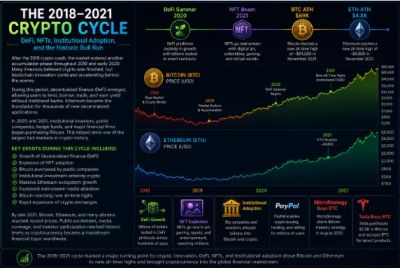
After the massive excitement and record highs of late 2017, the cryptocurrency market entered a severe bear market throughout 2018. Bitcoin lost more than 80% of its value from its peak, many ICO projects failed, and public interest in cryptocurrency declined dramatically. This period became known as the "Crypto Winter."
Despite falling prices, innovation within the blockchain industry continued to accelerate behind the scenes. Developers focused on building new technologies, improving blockchain infrastructure, and creating real-world applications for decentralized networks.
One of the most important developments during this cycle was the growth of Decentralized Finance (DeFi). Beginning in 2020, DeFi platforms allowed users to lend, borrow, trade, and earn interest on digital assets without relying on traditional banks or financial institutions. This period became known as "DeFi Summer."
Ethereum played a major role in powering the DeFi ecosystem through smart contracts. As adoption increased, billions of dollars flowed into decentralized applications and financial protocols.
At the same time, Non-Fungible Tokens (NFTs) exploded in popularity. NFTs introduced a new way to verify ownership of digital artwork, collectibles, gaming assets, music, and virtual real estate. Major brands, celebrities, artists, and athletes entered the NFT space, bringing cryptocurrency into mainstream culture.
Institutional adoption also accelerated during this cycle. Companies such as MicroStrategy began purchasing Bitcoin as a treasury reserve asset. Tesla announced a major Bitcoin investment, while PayPal added cryptocurrency services to its platform, exposing millions of users to digital assets for the first time.
As institutional participation increased, confidence returned to the market. Bitcoin and Ethereum experienced significant growth throughout 2020 and 2021, leading to new all-time highs and broader global adoption.
• The 2018 Crypto Winter and market correction
• The continued growth of Ethereum and smart contracts
• The rise of Decentralized Finance (DeFi)
• The DeFi Summer movement of 2020
• The NFT boom and digital collectibles revolution
• PayPal adding cryptocurrency services
• MicroStrategy adopting Bitcoin as a treasury asset
• Tesla purchasing Bitcoin
• Growing institutional investment in digital assets
• Bitcoin reaching approximately $69,000 in 2021
• Ethereum reaching approximately $4,800 in 2021
Between 2020 and 2021, cryptocurrency adoption expanded rapidly as investors, institutions, and corporations increasingly recognized the long-term potential of blockchain technology. What began as a recovery from the 2018 bear market evolved into one of the most significant growth periods in crypto history.
By late 2021, Bitcoin, Ethereum, NFTs, and DeFi had transformed cryptocurrency from a niche technology into a global financial and cultural movement.
This cycle demonstrated how innovation, institutional adoption, and real-world utility could drive long-term growth within the cryptocurrency industry while laying the foundation for the next phase of market evolution.
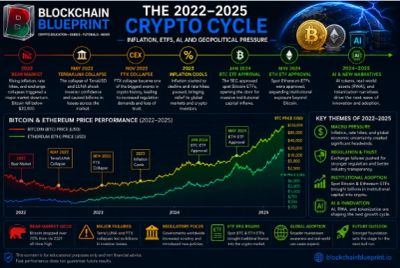
After the massive highs of 2021, the crypto market entered another major correction throughout 2022 and parts of 2023. Rising inflation, interest rate hikes, exchange collapses, and global economic uncertainty created heavy pressure across financial markets, including cryptocurrency.
This cycle became very different from previous crypto cycles because digital assets became more connected to global macroeconomic conditions and traditional financial markets.
Key events during this period included:
• Rising inflation worldwide
• Aggressive interest rate hikes by central banks
• Increased government regulation discussions
• Major crypto exchange failures
• Geopolitical wars and global instability
• Growing institutional interest in Bitcoin
• The launch and expansion of Bitcoin ETF products
• Rapid growth of artificial intelligence technologies and AI-related investments
As markets stabilized into 2024 and 2025, Bitcoin regained strength and institutional participation increased significantly through ETF adoption and broader mainstream exposure.
However, unlike some previous cycles, many altcoins did not experience the same level of explosive parabolic growth seen during earlier bull markets. Global uncertainty, geopolitical tensions, tariffs, liquidity concerns, and tighter financial conditions continued affecting market momentum.
This cycle reminded investors that cryptocurrency markets are no longer isolated from the rest of the global economy. Bitcoin, altcoins, stocks, interest rates, geopolitical events, and investor sentiment increasingly move together during periods of global uncertainty.
The 2022–2025 cycle also reinforced the importance of long-term investing, risk management, market psychology, and understanding accumulation phases during periods of fear and uncertainty.
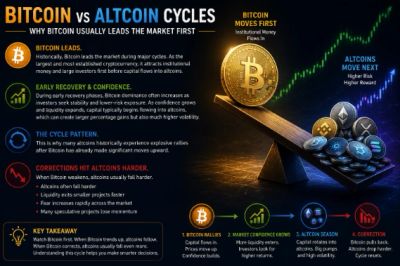
Historically, Bitcoin has usually led the crypto market during major cycles. Because Bitcoin is the largest and most established cryptocurrency, institutional money and large investors often enter Bitcoin first before moving into higher-risk altcoins later in the cycle.
During early recovery phases, Bitcoin dominance often increases as investors seek stability and lower-risk exposure within the crypto market. As confidence grows and liquidity expands, capital typically begins flowing into altcoins, which can create larger percentage gains but also much higher volatility.
This is why many altcoins historically experience explosive rallies after Bitcoin has already made significant moves upward.
However, the opposite is also true during market corrections.
When Bitcoin weakens:
• Altcoins often fall harder
• Liquidity exits smaller projects faster
• Fear increases rapidly across the market
• Many speculative projects lose momentum
Historically, Bitcoin has often reached major bottoms before many altcoins. Altcoins can continue falling for several months after Bitcoin stabilizes because they are generally more volatile and less predictable.
Historically, major Bitcoin bear market bottoms have often formed roughly 12–18 months after Bitcoin reaches major cycle highs. For example, after previous all-time highs in 2013, 2017, and 2021, Bitcoin later entered extended correction and accumulation phases before beginning new recovery cycles.
Although many altcoins can begin stabilizing around the same period Bitcoin reaches major bottoms, altcoins have historically remained far more volatile and unpredictable. According to historical market charts and previous crypto cycles, many altcoins continued declining for an additional 6–9 months after Bitcoin stabilized, with some projects falling 70% to 95% below previous highs.
Many investors study these historical timing patterns when analyzing long-term crypto market behavior. However, modern markets are increasingly influenced by global macroeconomic conditions, geopolitical events, regulation, liquidity, institutional participation, wars, tariffs, and broader financial market conditions, which can affect how future cycles develop.
Because exact market timing is extremely difficult, many long-term investors prefer using dollar cost averaging (DCA) strategies to gradually accumulate positions over time instead of attempting to perfectly predict tops and bottoms.
This is one reason many long-term investors focus heavily on Bitcoin accumulation during fear-driven markets while approaching altcoins with greater caution and risk management.
Understanding the relationship between Bitcoin dominance and altcoin volatility can help investors better recognize where the market may be within a larger crypto cycle.
This educational guide is based on historical market cycle observations and is not financial or investment advice.
Dollar Cost Averaging (DCA) is an investment strategy where investors gradually buy assets over time instead of attempting to perfectly predict market tops and bottoms.
Because cryptocurrency markets are highly volatile and emotional, many investors believe DCA can help reduce the stress and risk associated with short-term market timing.
Instead of investing all capital at once, DCA involves consistently accumulating positions during different market conditions, including:
• Fear
• Corrections
• Bear markets
• Recovery phases
• Periods of uncertainty
Historically, many long-term crypto investors have used DCA strategies to accumulate Bitcoin and select altcoins over extended periods of time.
The goal of DCA is not to perfectly time the market.
The goal is to:
• Reduce emotional decision-making
• Build positions gradually
• Manage volatility more effectively
• Focus on long-term adoption and utility
Many investors also believe stronger utility-based cryptocurrencies have historically demonstrated greater long-term resilience compared to highly speculative projects.
Examples of major cryptocurrencies many investors watch closely include:
• Bitcoin
• Ethereum
• Solana
• XRP
• Hedera
While no investment is guaranteed, many long-term investors believe patience, discipline, and gradual accumulation have historically outperformed emotional buying and panic selling during major crypto cycles.
This educational guide is based on historical market observations and is not financial or investment advice.

Cryptocurrency markets are heavily influenced by human psychology and emotional decision-making. Fear, greed, excitement, panic, and speculation have historically played major roles during every crypto market cycle.
During bull markets, excitement and media attention often attract large numbers of new investors into the market. As prices rapidly rise, many people experience FOMO, also known as the “Fear Of Missing Out.”
This emotional behavior can lead investors to:
• Chase rapidly rising prices
• Ignore risk management
• Buy near market tops
• Overinvest during periods of hype
• Make emotional trading decisions
During bear markets, the opposite often occurs.
As prices fall:
• Fear increases
• Panic selling begins
• Confidence disappears
• Retail participation declines
• Negative media coverage expands
Historically, many investors have sold during periods of extreme fear only to watch markets eventually recover later over time.
This emotional cycle of:
• Fear
• Disbelief
• Optimism
• Excitement
• Euphoria
• Panic
• Capitulation
• Recovery
has repeated throughout multiple crypto market cycles.
Understanding market psychology can help investors better recognize emotional behavior, avoid impulsive decision-making, and focus more on long-term strategy and risk management instead of short-term hype.
Many experienced investors believe emotional control is one of the most important skills in long-term investing because market psychology often drives short-term volatility more than fundamentals alone.
This educational guide is based on historical market observations and is not financial or investment advice.

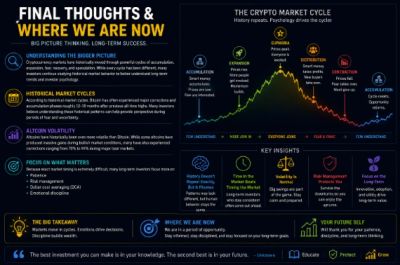
Cryptocurrency markets have historically moved through powerful cycles of accumulation, expansion, fear, recovery, and speculation. While every cycle has been different, many investors continue studying historical market behavior to better understand long-term trends and investor psychology.
According to historical market cycles, Bitcoin has often experienced major corrections and accumulation phases roughly 12–18 months after previous all-time highs. Many investors believe understanding these historical patterns can help provide perspective during periods of fear and uncertainty.
Altcoins have historically been even more volatile than Bitcoin. While some altcoins have produced massive gains during bullish market conditions, many have also experienced corrections ranging from 70% to 95% during major bear markets.
Because exact market timing is extremely difficult, many long-term investors focus more on:
• Patience
• Risk management
• Dollar cost averaging
• Emotional discipline
• Long-term utility and adoption
Modern crypto markets are also becoming increasingly connected to:
• Global liquidity
• Interest rates
• ETF adoption
• Inflation
• Artificial intelligence growth
• Wars and geopolitical events
• Government regulation and tariffs
This means future cycles may not perfectly repeat previous historical patterns.
Many investors continue watching major cryptocurrencies such as:
• Bitcoin
• Ethereum
• Solana
• XRP
• Hedera
because of their long-term development, infrastructure, adoption, and utility potential.
One of the biggest lessons throughout crypto history is that emotional decision-making often creates the largest mistakes during both bull markets and bear markets.
Historically, many investors buy aggressively during excitement and sell emotionally during fear. Long-term investors often attempt to do the opposite by focusing on accumulation during uncertainty and remaining disciplined during periods of hype.
Understanding crypto cycles does not guarantee future results.
However, studying historical market behavior, investor psychology, risk management, and long-term trends can help investors better navigate the volatility of cryptocurrency markets over time.
This educational guide is based on historical market observations and is not financial or investment advice.
The cryptocurrency market is constantly evolving, but education, risk management, and long-term thinking never go out of style.
At Blockchain Blueprint, our mission is to help beginners and experienced investors better understand cryptocurrency through free educational content, guides, tutorials, news, and tools.
Whether you're learning about Bitcoin, exploring altcoins, securing your assets, or studying market cycles, continuous learning can help you make more informed decisions throughout every stage of the market.
Learn the fundamentals of cryptocurrency, blockchain technology, digital assets, and how the crypto ecosystem works.
Learn how to safely store your cryptocurrency using hot wallets, cold wallets, hardware wallets, and proven security best practices.
Protect yourself from scams, phishing attacks, exchange risks, wallet vulnerabilities, and common mistakes made by new investors.
Explore recommended cryptocurrency wallets, exchanges, hardware wallets, portfolio trackers, security tools, tax software, and other useful crypto resources designed to help you navigate the digital asset ecosystem.
✔ Invest only what you can afford to lose
✔ Focus on long-term education rather than short-term hype
✔ Use proper risk management
✔ Dollar Cost Average when appropriate
✔ Never share your seed phrase or private keys
✔ Verify information from trusted sources
✔ Continue learning as the industry evolves
Helping everyday people understand cryptocurrency one lesson at a time.
🌐 Visit Us:
https://blockchainblueprint.io
Visit Blockchain Blueprint for free crypto education, guides, tutorials, news, market insights, and tools designed to help you navigate the cryptocurrency industry with confidence.
Thank you for reading the Crypto Cycle Cheat Sheet.
We look forward to helping you continue your crypto education journey.
This content is provided for educational purposes only and should not be considered financial, investment, tax, legal, or accounting advice. Cryptocurrency investments involve significant risk and volatility, and past performance does not guarantee future results. Always conduct your own research and consult qualified professionals before making financial decisions. Blockchain Blueprint does not guarantee the accuracy, completeness, or future performance of any information discussed within this guide.


Welcome to Blockchain Blueprint. Our goal is to help individuals understand blockchain technology, cryptocurrency, and how to navigate digital assets using the tools available on this platform.
We do not provide financial advice, investment recommendations, or trading guidance of any kind. Nothing on this website should be interpreted as advice to buy, sell, or invest in any asset.
All content is provided for educational and informational purposes only. By continuing, you acknowledge that you are responsible for your own decisions and actions.